
Daily brief · 2026-11-05
Historical edition · New York time. These observations reflect their published date, not current market conditions.
A dime over the zone — claims low, futures split, retest day
narrow pass, day one: one close $0.10 over the lost zone, breadth broad — claims low, BoE hikes, payrolls Friday grade it
Chart analysis
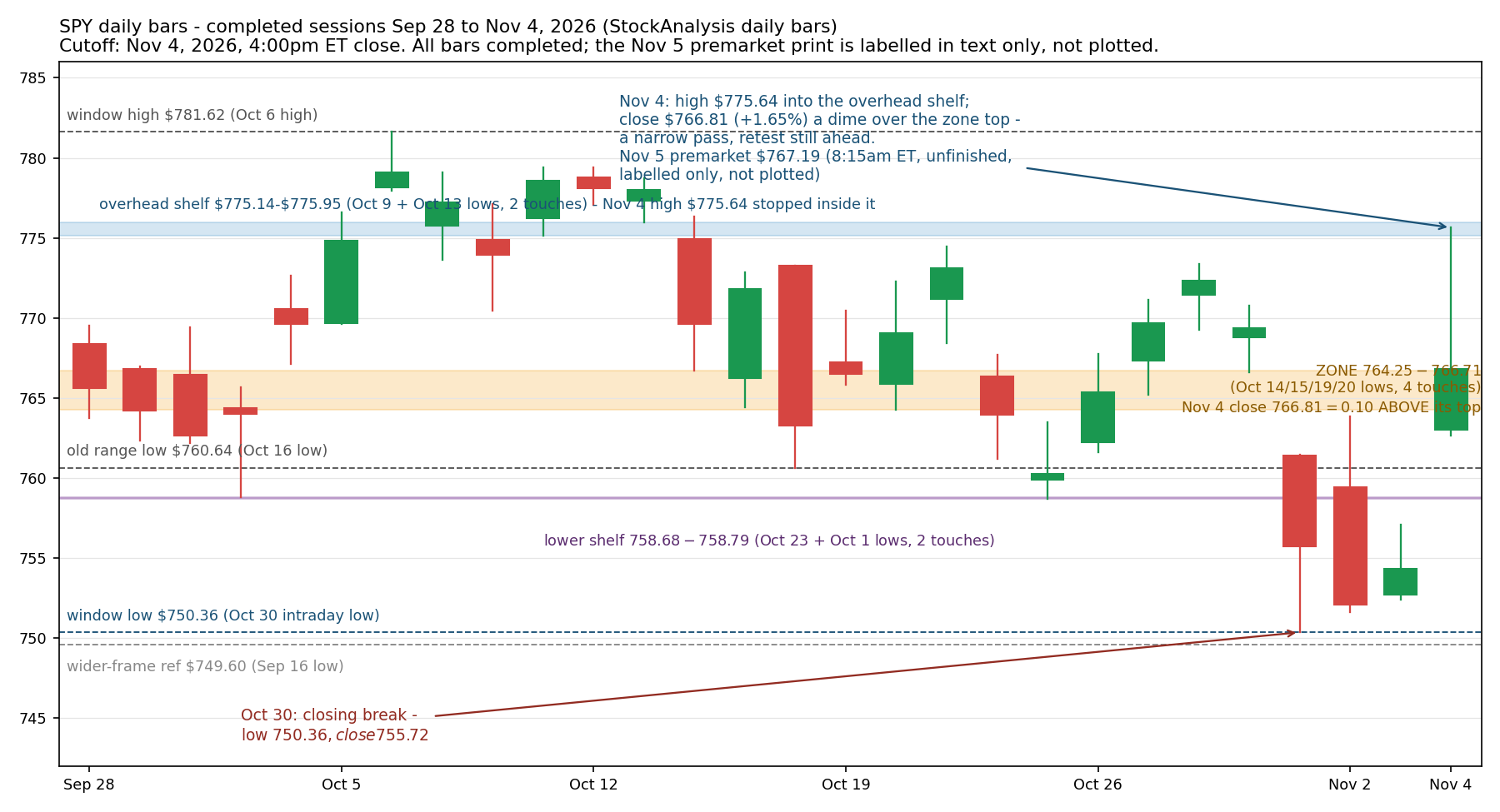
Published chart · Tap chart to enlarge.
Published chart lesson
A close above a lost level by a very small margin is graded as a narrow pass, not a reclaim. The grade has two steps: a completed close back above the level, then a later retest of that level from above that holds. SPY's lost zone is $764.25–$766.71, built from the Oct 14, Oct 15, Oct 19 and Oct 20 completed lows (StockAnalysis daily bars). Wednesday's completed bar closed at $766.81 — $0.10 above the zone top — after its high of $775.64 stopped inside the overhead shelf at $775.14–$775.95 (the Oct 9 and Oct 13 lows). That is step one, by the narrowest margin, and it is not established support. What would weaken the lesson: a completed close back below $766.71 would put the close inside the zone again and show the pass did not hold, and a completed close below $764.25, the zone bottom, would grade Wednesday's push a false break; a retest of the zone from above that holds, followed by a completed close above $775.95, would be the stronger evidence the other way.
Brief analysis source: SPY daily, StockAnalysis, Nov 4 2026 . Chart uses its own dated Yahoo series; vendor levels can differ.
Three key points
- Wednesday's completed bars produced the break's first repair evidence: SPY closed at $766.81, up 1.65% (StockAnalysis), $0.10 above the top of the lost $764.25–$766.71 zone — a narrow pass whose high of $775.64 was still turned back inside the $775.14–$775.95 overhead shelf.
- The morning's data kept rate pressure on: jobless claims fell to 189,000 against 196,000 expected (Labor Department, via FXStreet), the Bank of England hiked to 4.00%, the 10-year yield sat near 4.89%, and December Fed hike pricing firmed to 81.5% (CME FedWatch, late Nov 4) ahead of Friday's jobs report.
- Options learning point: one completed close above a lost zone is a narrow pass, not a confirmation — confirmation is a retest that holds, and with payrolls on Friday any premium sold before that print must survive it, while waiting puts no option premium at risk.
Read the full brief and sources
- Start with the widest frame, on completed daily bars. SPY (the S&P 500 ETF) on Wednesday opened at $762.99, reached $775.64, fell to $762.64 and closed at $766.81, up 1.65% (StockAnalysis daily bars, completed bar), on 62.1 million shares — nearly double Tuesday's 32.9 million. The completed Sep 28–Nov 4 window still runs from $781.62 (the Oct 6 high) down to $750.36 (the Oct 30 intraday low), so neither boundary moved. Behind the ETF, the S&P 500 index closed at 7,688.62, up 1.58%, and the Dow rose 3.03% (closing recaps, Nov 4). QQQ (the Nasdaq-100 ETF) opened at $688.43, reached $701.45, fell to $687.87 and closed at $691.95, up 0.97% (completed bar). One housekeeping note on the close itself: StockAnalysis's completed-bar table now reads $766.81 for SPY, while yesterday's postmarket brief, written on an earlier snapshot, carried $766.06 — that published brief stays as written under the append-only rule, and today's grading uses the provider's current completed-bar figure.
- Inside that frame, Wednesday's close changed the grade — by the smallest possible margin. The lost zone is $764.25–$766.71, built from four prior completed lows (Oct 14 at $766.71, Oct 15 at $764.43, Oct 19 at $765.82, Oct 20 at $764.25). The close at $766.81 sits $0.10 above the zone's top: a first completed close back above the zone, and by the graded rule that is a narrow pass, not a confirmation — confirmation needs a retest of the zone from above that holds. Above the close sits the next shelf at $775.14–$775.95, built from the Oct 9 and Oct 13 completed lows (two touches): Wednesday's high of $775.64 stopped inside it and the close fell back below it, so the day's push was turned back at the first overhead shelf. Below sit the old range low of $760.64 (the Oct 16 low) and the thin shelf at $758.68–$758.79 (the Oct 23 and Oct 1 lows, two touches), both reclaimed on Wednesday's close and now the first levels a retest would meet.
- This morning hands that narrow pass its retest, with the tape split. SPY traded at $767.19 in premarket at 8:15am ET, up 0.05% (StockAnalysis, unfinished) — just above the zone top, holding nothing yet. QQQ traded at $686.53 at 8:40am ET, down 0.78% from its close (Finnhub premarket, unfinished). Index futures pointed the same split way: Dow futures up about 0.7%, S&P 500 futures up about 0.1% and Nasdaq-100 futures down about 0.8% (Investopedia, this morning), while Qualcomm fell about 9% in premarket after its phone-chip sales missed estimates (Reuters, via The Retest morning brief). Overnight, Asia split along the same line: South Korea's Kospi closed 5.28% lower and Japan's Nikkei 225 fell 1.79% as chip names sold off, while Hong Kong's Hang Seng closed 3.67% higher (The Edge Asia wrap, Nov 5 closes). Brent crude was up about 3% to almost $98 a barrel and bitcoin traded above $79,600 (Investopedia, this morning), while spot gold rose 1.8% to $4,133.55 an ounce in early trading (Dow Jones Newswires via Morningstar, 1:02am ET). A premarket print grades nothing: today's completed close, not the morning's trade, decides whether the zone holds from above.
- Today's 8:30am ET release, weekly jobless claims, came in low: initial claims fell to 189,000 for the week ended Oct 31, below the 196,000 expected and the prior week's revised 195,000, with the four-week average down to 194,750 and continuing claims at 1.718 million (US Department of Labor figures, via FXStreet). A tight labour market is the backdrop the rate pricing is built on: the Bank of England raised its rate 25 basis points to 4.00% this morning on an 8–1 vote, with the one dissent arguing for 4.25% (Reuters), the 10-year Treasury yield sat near 4.89% this morning (Investopedia), and CME FedWatch pricing for a 25bp hike at the Dec 9 Fed meeting firmed to 81.5% in a late Nov 4 reading (BBX flash reading of CME FedWatch), up from 76.9% earlier on Nov 4. Retail sentiment, fresh this morning, moved the other way from price: the AAII survey for the week ended Nov 4 shows bullish 34.1% (down 3.7 points), bearish 48.4% (up 7.0 points — the most bearish in six weeks, and well above the 31.5% historical average), neutral 17.5%, for a bull-bear spread of −14.3% (AAII; MarketWatch). The survey ran Oct 29–Nov 4, so it covers the Oct 30 break and the election, but not Wednesday's rally or today's session — pessimism that rose into a rally is context, not a timing signal.
- This morning's BMO earnings, verified from official releases: ConocoPhillips reported EPS of $3.34, or $3.27 adjusted, and raised its quarterly dividend 11% (company release). Parker-Hannifin reported diluted EPS of $6.92, or $8.90 adjusted, on record sales of $6.0 billion and raised its full-year outlook (Globe Newswire release). Southern Company reported $1.77, or $1.94 adjusted, on revenues of $8,843 million (PR Newswire release); Duke Energy reported $1.99, both reported and adjusted, on revenues of $9,104 million (company Form 8-K release). Cigna reported shareholders' net income of $5.47 per share, or $7.98 per share on an adjusted basis, on total revenues of $73,683 million (PR Newswire release). Cummins reported GAAP diluted EPS of $8.25 on revenues of $9.4 billion (Business Wire release); Zoetis reported diluted EPS of $1.44, or $1.75 adjusted, on revenue of $2.4 billion (Business Wire release); Ralph Lauren reported diluted EPS of $4.87, or $4.64 adjusted, on revenue of $2.2 billion (Business Wire release). Today's full BMO slate is far larger than these headline names — the rest stays in the site's earnings checks as pending, not silently dropped.
Analyst interpretation: two things genuinely improved on Wednesday, and one thing did not. Participation repaired — 372 S&P 500 members rose against 127 that fell, with 72% of members above their 50-day average (ChartRow, Nov 4 close), the opposite of Tuesday's narrow bid — and SPY's completed close moved back above the lost zone. What did not improve is the margin: the close cleared the zone top by $0.10, the day's high was turned back inside the overhead shelf at $775.14–$775.95, and this morning QQQ trades lower in premarket while chip names lead the overseas falls. Retail investors, in the fresh AAII survey, grew more bearish into the rally (bearish 48.4%) — a reminder that a crowd can be wrong-footed, not evidence about what price does next. The calendar argues for the same patience: claims at 189,000 kept December hike pricing firm at 81.5% (CME FedWatch), and the October jobs report lands Friday at 8:30am ET, after Airbnb, Cloudflare and Microchip report following today's close. A hypothetical teaching example only — not a market quote and not a trade: in the Options Industry Council's terms, a put credit spread sells one put and buys a lower-strike put with the same expiry; sold for a hypothetical $1.10 credit on a $5-wide spread, its maximum gain is $1.10, its maximum loss is $3.90 plus fees, and its breakeven is the short strike minus $1.10. If the underlying expires between the strikes with the spread worth $2.00, the loss is $0.90 before fees — the full $3.90 is lost only at or below the long strike — and the short put carries assignment risk before expiry. A larger credit is not a higher win rate; the breakeven condition is what has to hold. Waiting puts no option premium at risk; its cost is possibly missing a further move, not a spread loss. A research question to study, not a recommendation: compare how often a first close back above a lost zone by less than a quarter of a percent held its retest, versus closes that cleared the zone by more — the evidence, not the size of one morning's move, is what would change the grade. With the retest scheduled for today's close and payrolls behind it, waiting is a valid position.
A completed close today above $766.71 — the top of the $764.25–$766.71 zone, set by the Oct 14 completed low — that is then held on a retest of the zone from above would grade Wednesday's narrow pass as repair in progress; a later completed close above $775.95, the top of the overhead shelf built from the Oct 9 and Oct 13 lows, would extend it.
A completed close back below $764.25, the zone's bottom (the Oct 20 completed low), would grade Wednesday's close a false break over the zone; a completed close below $760.64, the Oct 16 low and old range low, would reopen the path toward the $758.68–$758.79 shelf and the window low at $750.36.
Sources
- SPY daily bars (open/high/low/close, volume) and Nov 5 premarket print $767.19 at 8:15am ET (unfinished) — StockAnalysisNov 4, 2026, 4:00pm ET close (completed bars through Nov 4); premarket Nov 5, 2026, 8:15am ET
- QQQ daily bars (open/high/low/close) — StockAnalysisNov 4, 2026, 4:00pm ET close (completed bars through Nov 4)
- QQQ premarket print $686.53, down 0.78% from the Nov 4 close — FinnhubNov 5, 2026, 8:40am ET
- Futures this morning: Dow futures +0.7%, S&P 500 futures +0.1%, Nasdaq-100 futures −0.8%; 10-year Treasury yield near 4.89%; Brent crude +3% to almost $98; bitcoin above $79,600 (CoinDesk) — InvestopediaNov 5, 2026, morning ET
- Jobless claims: initial claims 189,000 for the week ended Oct 31, below 196,000 expected; prior week revised to 195,000; four-week average 194,750; continuing claims 1.718 million — FXStreet (US Department of Labor)Nov 5, 2026, 8:30am ET release
- Bank of England raised Bank Rate 25bp to 4.00% on an 8–1 vote, first hike since 2023; the dissent sought 4.25% — ReutersNov 5, 2026, 7:00am ET decision
- CME FedWatch: probability of a 25bp hike at the Dec 9, 2026 FOMC meeting at 81.5%, hold at 18.5% — BBX (CME FedWatch)Nov 4, 2026, 10:57pm UTC reading
- S&P 500 breadth at the Nov 4 close: 372 advancers / 127 decliners; 72% of members above their 50-day average (359 of 498 eligible), 66% above their 200-day average — ChartRowNov 4, 2026 close
- AAII Sentiment Survey, week ended Nov 4, 2026: bullish 34.1%, neutral 17.5%, bearish 48.4% — AAIINov 5, 2026 (survey week ended Nov 4, 2026)
- AAII: bearish 48.4% is the most bearish reading in six weeks; bullish 34.1% the lowest in five weeks — MarketWatchNov 5, 2026
- Asia closes Nov 5: Kospi −5.28% at 5,383.80, Nikkei 225 −1.79%, Hang Seng +3.67% at 24,796.98 — The Edge Asia wrapNov 5, 2026 (Asian session closes)
- Asia early trade: spot gold +1.8% at $4,133.55 an ounce; WTI futures −1.4% at $86.93 and Brent −0.8% at $93.85 in Asian trading — Dow Jones Newswires via MorningstarNov 5, 2026, 1:02am ET
- Qualcomm shares fell about 9% in premarket after smartphone chip sales missed estimates — Reuters, via The Retest morning briefNov 5, 2026, morning ET
- ConocoPhillips Q3 2026: reported EPS $3.34, adjusted EPS $3.27; quarterly dividend raised 11% to $0.93 — ConocoPhillips (official release)Nov 5, 2026
- Parker-Hannifin fiscal Q1 2027: reported diluted EPS $6.92, adjusted EPS $8.90, record sales $6.0 billion; full-year outlook raised — Globe Newswire (official release, via Quantisnow)Nov 5, 2026, 7:30am ET
- Southern Company Q3 2026: reported EPS $1.77, adjusted EPS $1.94, operating revenues $8,843 million — PR Newswire (official release, via Ad-hoc News)Nov 5, 2026
- Duke Energy Q3 2026: reported and adjusted EPS $1.99, revenues $9,104 million; 2026 adjusted EPS guidance narrowed to $6.70–$6.80 — company Form 8-K release (via Ad-hoc News)Nov 5, 2026
- Cigna Group Q3 2026: shareholders' net income $5.47 per share, adjusted income from operations $7.98 per share, total revenues $73,683 million — PR Newswire (official release, via Morningstar)Nov 5, 2026
- Cummins Q3 2026: GAAP diluted EPS $8.25, revenues $9.4 billion — Business Wire (official release, via Morningstar)Nov 5, 2026
- Zoetis Q3 2026: diluted EPS $1.44, adjusted diluted EPS $1.75, revenue $2.4 billion — Business Wire (official release)Nov 5, 2026
- Ralph Lauren fiscal Q2 2027: reported diluted EPS $4.87, adjusted diluted EPS $4.64, revenue $2.2 billion — Business Wire (official release)Nov 5, 2026
Narrow pass fails: SPY plunges 4.35% through every shelf to a new window low
false break graded: one-day pass over the zone reversed in full — chips rout, breadth 74 up / 426 down, payrolls Friday now grade the damage
Chart analysis
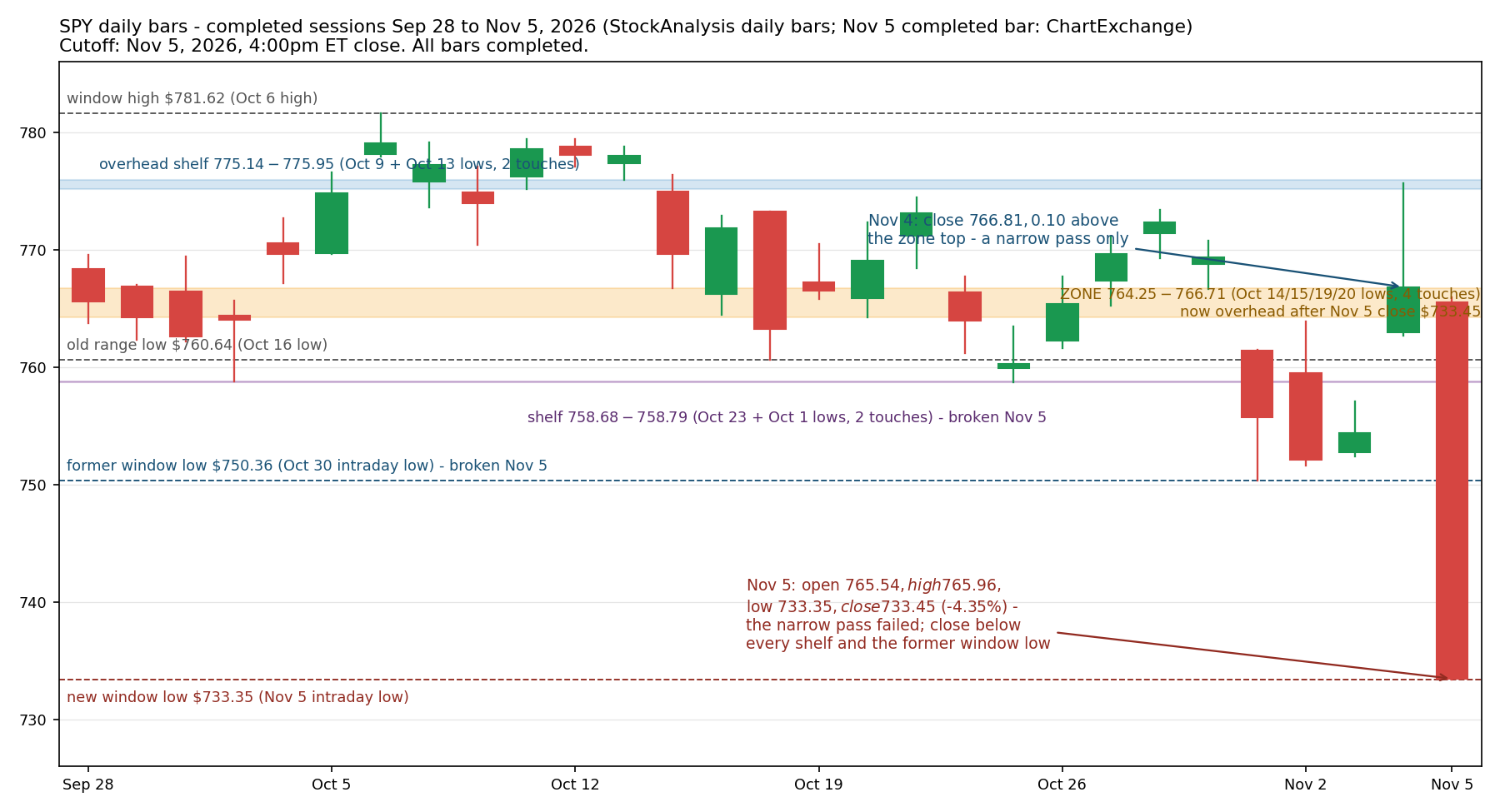
Published chart · Tap chart to enlarge.
Published chart lesson
A first close above a lost zone by a very small margin is a narrow pass, not a reclaim — and a reclaim claim is only settled by the retest. SPY's lost zone is $764.25–$766.71, built from the Oct 14, Oct 15, Oct 19 and Oct 20 completed lows (StockAnalysis daily bars). Wednesday's completed close at $766.81 cleared the zone top by $0.10; today's completed bar opened inside the zone at $765.54 and closed at $733.45 (ChartExchange completed bar), below the zone bottom, the $760.64 old range low, the $758.68–$758.79 shelf and the former window low of $750.36, printing a new window low at $733.35. That grades Wednesday's pass a false break: the level was visited and briefly cleared, but it was never held from above. What would weaken the lesson: a completed close back above $750.36, the former window low, followed by a held retest of that level from above, would show demand returning at a named level rather than a one-day bounce; until a completed close reclaims a named level and holds it, every level above today's close stays overhead, not support.
Brief analysis source: SPY daily, StockAnalysis (through Nov 4) and ChartExchange (Nov 5 completed bar), Nov 5 2026 . Chart uses its own dated Yahoo series; vendor levels can differ.
Three key points
- The narrow pass failed: SPY closed at $733.45, down 4.35% (ChartExchange completed bar) — below the $764.25–$766.71 zone, the $760.64 old range low, the $758.68–$758.79 shelf and the former $750.36 window low, setting a new window low at $733.35 as the S&P 500 fell about 4.3%, its worst day since April 2025 (Bloomberg via The Private Banker).
- The rout was chip-led and broad: the PHLX Semiconductor index fell 12.25% to 9,011.14, only 74 S&P 500 members rose against 426 decliners (ChartRow, Nov 5 close), and the selling coincided with firm labour data — claims at 189,000 (Labor Department, via FXStreet) — while the 10-year yield fell to about 4.82% (CoinDesk).
- Options learning point: a first close above a lost zone by $0.10 was a narrow pass, not a reclaim, and it failed the next day — with Friday's jobs report still ahead, any premium sold before that print must survive it, while waiting puts no option premium at risk.
Read the full brief and sources
- Start with the widest frame, on completed daily bars. SPY (the S&P 500 ETF) opened at $765.54, reached $765.96, fell to $733.35 and closed at $733.45, down 4.35% (ChartExchange completed bar), on 99.6 million shares — well above Wednesday's 62.1 million. That close is below every level in the completed Sep 28–Nov 5 window: the window that ran from $781.62 (the Oct 6 high) to $750.36 (the Oct 30 intraday low) now has a new low at $733.35. Behind the ETF, the S&P 500 index fell about 4.3% — its steepest one-day decline since April 2025 — the Dow lost 1,833.06 points, or 3.4%, to 51,523.06, and the Nasdaq Composite dropped 5.5% to close in correction territory, more than 10% below its Oct 6 record (closing recap, Bloomberg via The Private Banker). QQQ (the Nasdaq-100 ETF) opened at $683.12, reached $683.65, fell to $647.05 and closed at $647.05, down 6.49% (Finnhub regular-session close) — closing on its low, because the day's selling was led by the chip names QQQ holds most.
- Grade the day against the test the morning brief set, on completed bars — it failed at every step. The morning's rule: a completed close above $766.71, the top of the $764.25–$766.71 zone (built from the Oct 14, Oct 15, Oct 19 and Oct 20 completed lows, four touches), held on a retest, would grade Wednesday's narrow pass as repair; a completed close back below $764.25, the zone bottom, would grade it a false break. Today's open at $765.54 was already inside the zone, and the completed close at $733.45 is below the zone bottom, below the old range low of $760.64 (the Oct 16 low), below the thin shelf at $758.68–$758.79 (the Oct 23 and Oct 1 lows, two touches) and below the former window low of $750.36 — so Wednesday's $0.10 pass over the zone is graded a false break, and the break that began on Oct 30 has extended to a new window low. Every one of those levels is now overhead, not support: on any later bounce they are the levels a recovery would have to reclaim, in reverse order.
- Participation collapsed with price, while the day's labour data stayed firm. At the 4:00pm ET close 74 S&P 500 members rose against 426 that fell (ChartRow, Nov 5 close) — the mirror image of Wednesday's 372 advancers against 127 decliners. The morning's jobless claims had already printed low at 189,000 against 196,000 expected (US Department of Labor, via FXStreet), and a Challenger, Gray & Christmas report showed US employers announced the fewest layoff plans since 2023 in October (via The Private Banker) — the selling coincided with firm labour data, not weak data, which is why it reads as a repricing of the chip and data-center trade rather than a growth scare in today's evidence. The 10-year Treasury yield fell about 7 basis points to 4.82% late in the session (CoinDesk) while the VIX rose about 56% to 25.84 at 3:42pm ET (Pulsafi) — yields fell as stocks fell, the opposite pattern from a rate-driven selloff.
- The rest of the board, in one compressed pass. The PHLX Semiconductor index plunged 12.25% to 9,011.14; Micron fell about 17%, AMD roughly 15%, Nvidia about 9% and Tesla more than 10% (The Private Banker, citing Bloomberg). Retail investors sold a net $358 million of individual US stocks as of 2:58pm ET, on pace for the largest single-day net selling since March 17, 2020 (Vanda, via The Private Banker). Brent crude traded around $98 a barrel and WTI around $90, up about 3% on the day (The Private Banker), spot gold was ahead 0.6% at $4,094 an ounce late in the session, off its earlier highs (CoinDesk), and bitcoin traded just below $76,000, down 5.2% over 24 hours, with ether at $2,229, down 7.5% (CoinDesk, late update).
- Tonight's earnings are a separate, later development — they did not decide today's 4:00pm ET close, and their first full-session grade comes tomorrow. Airbnb beat on both lines for the third quarter: diluted EPS of $3.16 against $2.85 expected (FactSet, via WSJ), revenue up 19% to $4.87 billion against $4.75 billion expected, gross booking value up 21% to $27.7 billion, and the company raised its full-year revenue outlook to high-teens growth and added a $12 billion buyback (WSJ; Finimize). Cloudflare and Microchip Technology had not released verified results at this check and were still to come later this evening. A question to study, not a trade: the narrow pass failed on a day when the labour data was firm and yields fell — what would Friday's jobs report and Friday's completed close need to show for today's new low to count as a one-day washout rather than the start of a lower range?
Analyst interpretation: Wednesday's repair evidence was real but minimal — a $0.10 close over the zone, on broad participation — and today showed why the grade was kept at a narrow pass rather than a confirmation. The retest the morning brief asked for arrived the same day and failed at every level at once: the zone, the old range low, the shelf and the former window low all gave way on one completed bar, on volume well above Wednesday's, with 426 decliners against 74 advancers (ChartRow). Two things in today's evidence argue against reading this as a rates or growth shock: the 10-year yield fell to about 4.82% as stocks fell (CoinDesk), and the day's labour data — claims at 189,000 and the fewest announced layoff plans since 2023 (Challenger, via The Private Banker) — was firm. What the evidence does support is a repricing centred on the chip and data-center names that led the autumn advance, coinciding with a reassessment of what the election result means for that build-out (The Private Banker, citing Bloomberg) — a theme unwind, graded by price, not a verdict on the economy. A hypothetical teaching example only — not a market quote and not a trade: in the Options Industry Council's terms, a put credit spread sells one put and buys a lower-strike put with the same expiry; sold for a hypothetical $1.10 credit on a $5-wide spread, its maximum gain is $1.10, its maximum loss is $3.90 plus fees, and its breakeven is the short strike minus $1.10. If the underlying expires between the strikes with the spread worth $2.00, the loss is $0.90 before fees — the full $3.90 is lost only at or below the long strike — and the short put carries assignment risk before expiry. A larger credit is not a higher win rate; the breakeven condition is what has to hold. On a day when the index fell 4.35%, a spread whose breakeven sat inside that move would be tested in full — which is the practical meaning of event risk when a jobs report is still ahead on Friday. Waiting puts no option premium at risk; its cost is possibly missing a rebound, not a spread loss. A research question to study, not a recommendation: compare first closes back above a lost zone by less than a quarter of a percent that then failed within one session, versus those that held a retest — today's bar is now one data point in that study. With a new window low printed and payrolls on Friday, waiting is a valid position.
A completed close on Friday below $733.35 — today's intraday low and the new window low — would confirm the break has extended and that no named level in the Sep 28–Nov 5 window held; a completed close that stays below $750.36, the former window low (the Oct 30 intraday low), keeps every reclaimed level unproven and the false-break grade in place.
A completed close back above $750.36, the former window low, that is then held on a retest of that level from above would invalidate the extension read and grade today as a one-day washout at a named level; a later completed close above $758.79, the top of the $758.68–$758.79 shelf built from the Oct 23 and Oct 1 lows, would be the next step of evidence the other way.
Opened new positions today, on confirmed fills recorded in the journal.
Sources
- SPY Nov 5 completed daily bar (open $765.54 / high $765.96 / low $733.35 / close $733.45, -4.35%, volume 99.6 million) and Nov 4 bar — ChartExchangeNov 5, 2026, 4:00pm ET close (completed bar)
- SPY daily bars Sep 28–Nov 4 (open/high/low/close, volume) — StockAnalysisNov 4, 2026, 4:00pm ET close (completed bars through Nov 4)
- QQQ Nov 5 regular-session close $647.05, down 6.49% (open $683.12 / high $683.65 / low $647.05) — FinnhubNov 5, 2026, regular-session close
- Closing recap: S&P 500 fell about 4.3%, its steepest one-day decline since April 2025; Nasdaq Composite dropped 5.5% to close in correction territory; Dow lost 1,833.06 points, or 3.4%, to 51,523.06; PHLX Semiconductor index plunged 12.25% to 9,011.14; Micron about -17%, AMD roughly -15%, Nvidia about -9%, Tesla more than -10%; retail net selling $358 million as of 2:58pm ET (Vanda); Brent around $98 and WTI around $90, up about 3% — The Private Banker (sources: Yahoo Finance, Bloomberg)Nov 5, 2026, 4:10pm ET (published 21:10 UTC)
- S&P 500 breadth at the Nov 5 close: 74 advancers / 426 decliners — ChartRowNov 5, 2026, 4:00pm ET
- Jobless claims: initial claims 189,000 for the week ended Oct 31, below 196,000 expected — FXStreet (US Department of Labor)Nov 5, 2026, 8:30am ET release
- Late-session cross-asset read: 10-year Treasury yield down 7 basis points to 4.82%; bitcoin just below $76,000, down 5.2% over 24 hours; ether $2,229, down 7.5%; spot gold ahead 0.6% at $4,094 an ounce, off earlier highs — CoinDesk live updatesNov 5, 2026, late session ET
- Market pulse at 3:42pm ET: S&P 500 7,366.40, down 4.19%; VIX 25.84, up about 56%; 10-year yield 4.84%, down 6 basis points — PulsafiNov 5, 2026, 3:42pm ET (intraday snapshot, not the close)
- Airbnb Q3 2026: profit of $1.89 billion, or $3.16 a share, against $2.85 expected (FactSet); revenue up 19% to $4.87 billion against $4.75 billion expected; gross booking value up 21% to $27.7 billion; full-year revenue outlook raised to high-teens growth; Q4 revenue guide $3.22–$3.28 billion — WSJNov 5, 2026, after the close
- Airbnb Q3 2026: nights and seats booked up 16% to 155 million; revenue $4.87 billion; diluted EPS $3.16, up from $2.21 a year earlier; $12 billion buyback authorized; 2026 revenue growth outlook raised to the high teens — FinimizeNov 5, 2026, after the close (published 21:07 UTC)