
Daily brief · 2026-10-21
Historical edition · New York time. These observations reflect their published date, not current market conditions.
SPY presses the 772-773 shelf - today's close grades the test, not tonight's earnings
Revised 2:08pm ET, Oct 21 - owner-authorized revision in the new chart-first format; range-window labels, the close-before-earnings chronology, options-payoff wording and the OIC name corrected 2:17pm ET the same day, and an annotated chart added. The original edition (published 8:57am ET) is preserved verbatim in this file's revision history and in git; the morning sections keep the original pre-open information cutoff, and the intraday addendum is separately timestamped - intraday prices are unfinished-session observations, not morning facts.
A shelf test is a scenario to price, not a direction to guess: today's intraday addendum works a hypothetical SPY call spread through its breakeven — and shows why waiting for the completed close is a position, not a delay.
range repair, not a new trend: SPY mid-range pressing a three-touch shelf, QQQ still inside its zone, 10-year above 5.1%
Chart analysis
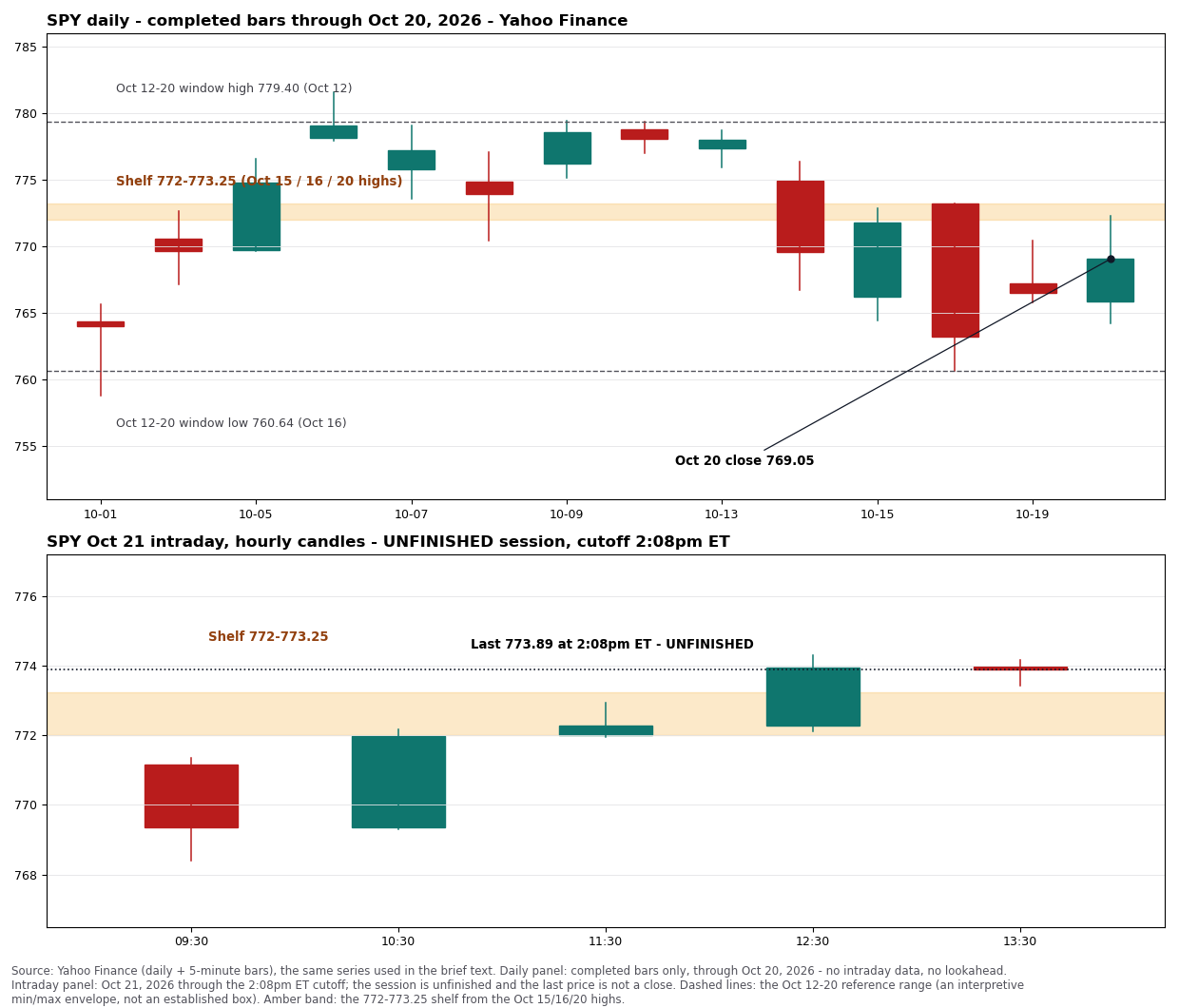
Published chart · Tap chart to enlarge.
Published chart lesson
A shelf is a zone with a memory. SPY's $772–$773.25 shelf is not a round number or an indicator — it is where three separate pushes stopped on completed daily bars (Oct. 15 high $772.87, Oct. 16 high $773.25, Oct. 20 high $772.29, Yahoo Finance). Price returning to a shelf is a test; the grade comes from the completed close and what follows it. A close above the shelf that survives a retest — price dipping back to the shelf and holding — flips it from ceiling to floor. A close back inside grades the push a false break, and the shelf's cap is stronger for having been tested again. Confirmation is graded, not binary: one close is a pass with a thin margin, a held retest is a pass with evidence. The lesson weakens if the shelf stops mattering — if SPY starts closing through it in both directions without reaction, the zone has been absorbed and the map needs redrawing.
Brief analysis source: SPY, QQQ and GLD daily bars and BTC-USD UTC daily bars, Yahoo Finance, completed sessions through Oct 20, 2026; intraday addendum prices, Yahoo Finance, as of 2:08pm ET, Oct 21, 2026 (unfinished bars, labelled in the text) Annotated chart: /today/2026-10-21-spy-shelf.png (same Yahoo series; daily panel completed through Oct 20, intraday panel cutoff 2:08pm ET, unfinished). . Chart uses its own dated Yahoo series; vendor levels can differ.
Three key points
- On completed Oct. 20 bars, SPY closed at $769.05, mid-range inside the Oct 12-20 reference range of $760.64-$779.40 and below the $772–$773.25 shelf — the Oct. 15–16 highs (Yahoo Finance daily bars) that have capped three pushes this month.
- QQQ closed at $717.63, below its $724.55–$729.43 zone, so tech has not joined the repair; breadth improved Tuesday (402 advancers vs 98 decliners, ChartRow), today's dated tests are the 4:00pm ET close against the shelves and the 20-year auction; Meta and Tesla report after tonight's close - their after-hours response and tomorrow's session are the next test - and the Fed meets Oct. 27-28.
- For options learners: structure sets the scenario, the scenario sets the strategy — a defined-risk spread's reward-to-risk is not its win rate; the worked hypothetical in the intraday addendum prices the breakeven, and waiting for confirmation is a valid choice.
Read the full brief and sources
- The higher-timeframe picture is a recent range, not a breakout. Over the Oct 12-20 window, SPY traded between $760.64 (the window low, Oct. 16) and $779.40 (the window high, Oct. 12) on completed daily bars (Yahoo Finance) - a min/max envelope used here as an interpretive reference range, not an established box; the full Oct. 1-20 span is wider, $758.79-$781.62. Tuesday's close at $769.05 sits near the middle of the recent range. QQQ's Oct 12-20 window runs $707.23-$749.79, and its $717.63 close sits in the lower third. Until a completed close escapes the range, the honest description is repair inside it: each push toward a boundary is a test, and tests are graded by the close, not by the intraday high.
- Inside the box, two shelves frame the session. SPY's $772–$773.25 shelf is built from three completed-bar touches — the Oct. 15 high of $772.87, the Oct. 16 high of $773.25 and Tuesday's high of $772.29 — each followed by a close back below it. QQQ's equivalent zone is $724.55–$729.43 (the Oct. 19 and Oct. 15 highs). A completed close above a shelf, followed by a retest that holds it, would confirm the shelf has flipped from cap to floor; a close back inside the shelf makes the push a false break for now. Neither has happened yet on completed bars - that grading waits for today's 4:00pm ET completed close, which comes BEFORE tonight's earnings: Meta and Tesla report after the close, so their after-hours response and tomorrow's full session grade the follow-through, not today's test.
- Breadth supports 'repair' over 'collapse' — narrowly. At Tuesday's close, 402 S&P 500 members advanced against 98 decliners, 52% of members closed above their own 50-day average, and new highs beat new lows 28 to 1 (ChartRow, Oct. 20 close). The equal-weight S&P 500 rose 1.15% against the cap-weighted index's 0.28%, and the Russell 2000 rose 1.65% (alphamaxing) — the average stock did the work. One broad day inside a box is evidence of demand at these levels, not of a new trend.
- The day's catalysts are dated, and this morning's earnings explained why they matter. Philip Morris (adjusted EPS $2.36 vs $2.29 expected, Reuters), AT&T ($0.65 vs $0.60, guidance raised, Barron's) and Danaher ($2.11, outlook raised, Dow Jones) all beat — and all were sold before the open on guidance and costs. The lesson for tonight: Meta Platforms and Tesla will be graded the same way, on AI spending and margins, not on the profit line alone. There is no 8:30am ET release today; the $13 billion 20-year Treasury auction at 1:00pm ET tests demand for long-term debt with the 10-year yield near 5.10%, and the Fed meets Oct. 27–28 with a hold priced at roughly 85% (LSEG via Morningstar).
- Research candidates — questions to study, not trades to take: (1) Shelf behaviour: how have SPY's three touches of $772–$773.25 differed in follow-through, and what did the session after each touch do? (2) The laggard: GLD closed Tuesday at $377.65, below its own $380.88–$384.88 zone (the Oct. 20 and Oct. 16 highs) — the gold ETF is testing from underneath while equities repair, so which shelf resolves first? (3) Bitcoin on UTC daily bars closed at $82,941, just under its $83,072–$83,288 shelf (the Oct. 19–20 highs) — a third asset parked at the same kind of boundary. Three shelves, three assets: the research task is comparing how each test resolves on completed bars.
- INTRADAY ADDENDUM — 2:08pm ET, session unfinished; these are intraday observations, not morning facts and not completed bars. SPY last traded at $773.89, above the $772-$773.25 shelf after a $774.29 intraday high (Yahoo Finance 5-minute bars through the 2:08pm ET cutoff) — a test in progress: it confirms nothing until the completed close, and a close back below $772 would grade it a false break. QQQ, at $726.69, is inside its $724.55–$729.43 zone but has not reclaimed the $729.43 top — no reclaim is asserted. GLD, at $379.24, remains below its $380.88–$384.88 zone (GLD is the gold ETF, not spot gold). Bitcoin, at about $84,649 on the unfinished UTC day bar, sits above its $83,072–$83,288 shelf. The 1:00pm ET 20-year auction is complete: it sold at a 5.469% high yield, tailing the pre-auction level by 0.9 basis points with a 2.73x bid-to-cover (investinglive), and yields were steady afterwards (MarketWatch) — the duration test passed without disruption while megacap tech and crypto led the midday tape (MarketOne).
- INTRADAY ADDENDUM — OPTIONS EDUCATION (hypothetical example; the premium is invented for teaching — it is not a market quote, a listed expiry, or a recommendation). Scenario first: suppose a learner expects SPY to hold above its shelf but wants defined risk into an event-heavy stretch. One textbook structure for that scenario is a bull call spread (Options Industry Council, linked in sources): buy the 775 call, sell the 780 call, same expiry — here a hypothetical expiry about 30 days out — for a hypothetical debit of $1.50 a share. With the standard 100-share multiplier, the most that can be lost is the debit: $150 a spread, reached at any expiry price at or below 775. The most that can be gained is $350 a spread — the $5 width minus the $1.50 debit — at any expiry price at or above 780. Breakeven at expiry is 776.50, so reward-to-risk is 2.33 to 1; at an expiry price of 778 the spread is worth $3.00 a share, a $150 gain. All figures are before fees and commissions. Two cautions the arithmetic hides: 2.33-to-1 is not a win rate — profit needs SPY above 776.50 at expiry, and a sideways month still loses money - at an expiry price of 776 the spread is worth $1.00 a share, a $50 loss; the full $150 debit is lost only at or below 775; and the short 780 call carries assignment risk, including early assignment around ex-dividend dates, which can leave the holder with a share position to manage. The alternative strategy is waiting — for the completed close and the retest — which puts no option premium at risk and is a complete decision, not a missed one.
Analyst interpretation: Tuesday improved the range's internals without changing its boundaries. Breadth broadened, small caps led, and this morning's sellers punished guidance rather than profits — a tape that is repairing, inside a range, under a 10-year yield above 5.1%. Through a conservative put-seller's lens, the structure argues for letting the shelves and the dated events do the grading: today's completed close against the shelf, tonight's after-hours response to Meta and Tesla, the retest that follows any shelf break, and the Oct. 27-28 Fed meeting. An intraday poke above a shelf is information; treating it as confirmation is how range trades turn into chase trades. Waiting for the completed bar is not hesitation — in a box, it is the strategy.
A completed SPY close above $773.25 — the top of its shelf on completed bars (Yahoo Finance) — that then survives a retest (a later session dipping toward the shelf and closing back above it), together with a completed QQQ close above $729.43, the top of its zone, would confirm the shelves are flipping from caps to floors and the Oct 12-20 range is resolving upward.
A completed SPY close back below $772, inside the shelf, after an intraday push above it would grade the push a false break; a QQQ close below $724.55 would show its zone rejected from inside; and a completed SPY close below $760.64, the Oct 12-20 window low, would end the repair reading altogether and reopen the lower half of the month's range.
Before tonight's close, write down three numbers: (1) the completed SPY close that would confirm the $772–$773.25 shelf break, (2) the close that would grade today's intraday push a false break, and (3) the expiry price the hypothetical 775/780 call spread needs just to break even — then check which of the three the market actually delivered.
Sources
- SPY daily bars: Oct. 12 high $779.40, Oct. 16 low $760.64, highs of $772.87 (Oct. 15), $773.25 (Oct. 16) and $772.29 (Oct. 20), Oct. 20 close $769.05; intraday Oct. 21 as of 2:08pm ET — Yahoo FinanceCompleted sessions through Oct 20, 2026; intraday Oct 21, 2026, 2:08pm ET (unfinished)
- QQQ daily bars: zone highs $724.55 (Oct. 19) and $729.43 (Oct. 15), Oct 12-20 window $707.23-$749.79, Oct. 20 close $717.63; intraday Oct. 21 as of 2:08pm ET — Yahoo FinanceCompleted sessions through Oct 20, 2026; intraday Oct 21, 2026, 2:08pm ET (unfinished)
- GLD daily bars: zone highs $380.88 (Oct. 20) and $384.88 (Oct. 16), Oct. 20 close $377.65; intraday Oct. 21 as of 2:08pm ET — Yahoo Finance (GLD is the gold ETF, not spot gold)Completed sessions through Oct 20, 2026; intraday Oct 21, 2026, 2:08pm ET (unfinished)
- BTC-USD UTC daily bars: shelf highs $83,072 (Oct. 19) and $83,288 (Oct. 20), Oct. 20 UTC close $82,941; Oct. 21 UTC bar in progress — Yahoo FinanceCompleted UTC days through Oct 20, 2026; Oct 21, 2026, 2:08pm ET (unfinished)
- S&P 500 breadth at the Oct. 20 close: 52% of members above their 50-day average (259 of 499), advancers 402 vs decliners 98, new highs 28 vs new lows 1 — ChartRowOct 20, 2026, market close
- Tuesday completed bars and session detail: S&P 500 +0.28% to 7,712.57; Dow +1.02% to 52,495.88; Nasdaq -0.02% to 26,424.82; equal-weight S&P +1.15%; Russell 2000 +1.65% — alphamaxing pre-market scanOct 21, 2026, before the open, on Oct 20 completed bars
- Futures recently: S&P 500 +0.3%, Nasdaq +0.7%, Dow +0.2%; 10-year yield ticked lower to 5.10%; WTI $98.40, gold near $4,160, bitcoin near $83,400 — InvestopediaOct 21, 2026, morning ET before the open
- Philip Morris Q3 2026: adjusted profit $2.36 a share vs $2.29 LSEG estimate, warned on conflict-related costs, shares down 3% premarket — ReutersOct 21, 2026, before the open
- AT&T Q3 2026: adjusted EPS $0.65 vs $0.60 FactSet estimate, full-year guidance raised, shares down more than 5% premarket — Barron'sOct 21, 2026, before the open
- Danaher Q3 2026: adjusted EPS $2.11 vs $1.91 FactSet estimate, full-year adjusted EPS guidance raised to $8.57–$8.62 — Dow Jones via MorningstarOct 21, 2026, 6:32am ET
- 10-year Treasury yield in Asian trade; money markets price about 85% probability of no change at the Fed's Oct. 28 decision (LSEG); $13B 20-year bond auction due today — Morningstar/Dow JonesOct 21, 2026, 2:32am ET
- 20-year auction results: $13B sold at a 5.469% high yield, 0.9bp tail vs the 5.460% pre-auction level, bid-to-cover 2.73x, directs 31.6% — investingliveOct 21, 2026, 1:03pm ET
- Treasury yields steady after the 20-year auction tailed by nearly a basis point — MarketWatch live coverageOct 21, 2026, after 1:00pm ET
- Midday tape: megacap tech leads (QQQ +1.3% at midday vs SPY +0.5%), Meta +2.5% ahead of tonight's results, breadth thinner underneath — MarketOneOct 21, 2026, midday ET
- Bull call spread (debit call spread): structure, maximum gain, maximum loss and breakeven definitions — Options Industry Council (OIC)Reference page, accessed Oct 21, 2026
Educational only — not investment advice. The call-spread example uses a hypothetical premium invented for teaching; it is not a market quote, a listed expiry, or a recommendation. Intraday addendum prices are unfinished-session observations as of 2:08pm ET and can change before the close.
SPY closes above its shelf at $774.31 — a narrow pass; the retest is still to come
first close above the shelf, not yet a confirmed break: SPY over $773.25, QQQ still inside its zone, 10-year at 5.145%
Chart analysis
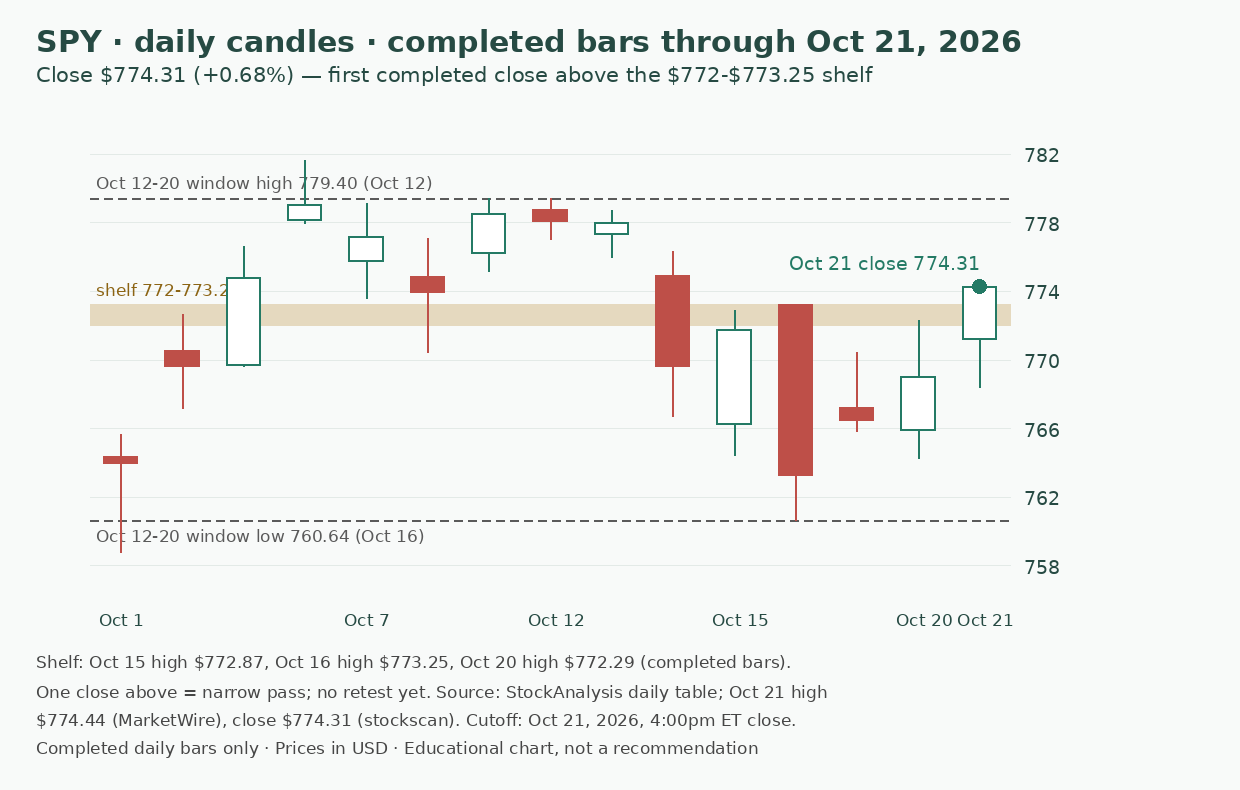
Published chart · Tap chart to enlarge.
Published chart lesson
One close is a narrow pass; a held retest is evidence. A shelf break is graded in stages: SPY's $772–$773.25 shelf was built by three completed-bar highs (Oct. 15 $772.87, Oct. 16 $773.25, Oct. 20 $772.29), and today's completed close at $774.31 (stockscan, Oct. 21 close) clears the top by $1.06 — stage one passed. Stage two is the retest: a later session that dips back toward the shelf and closes above it shows the ceiling has become a floor; until that happens, the break has been stated but not defended. The lesson weakens if SPY closes back below $772, inside the shelf — that would grade today's push a false break and make the shelf's cap stronger for having been tested a fourth time.
Brief analysis source: SPY daily bars, StockAnalysis history table and stockscan closing price $774.31, Oct 21 2026 completed session; shelf highs Oct 15/16/20, Yahoo Finance via the Oct 21 premarket brief . Chart uses its own dated Yahoo series; vendor levels can differ.
Three key points
- SPY closed at $774.31 on completed Oct. 21 daily bars (stockscan), above the $773.25 top of its three-touch $772–$773.25 shelf — by the morning's grading that is a narrow pass, and the S&P 500 index rose 0.58% to 7,757.17 (WSJ).
- QQQ closed at $725.20, inside its $724.55–$729.43 zone rather than above it (Finnhub), breadth was 283 advancers against 216 decliners (ChartRow, Oct. 21 close), and Meta and Tesla reported only after the 4:00pm ET close — tonight's results grade Thursday's session, not today's test.
- For options learners: the 10-year yield rose to 5.145% on the day (WSJ) while Meta rose about 4.0% and Tesla about 1.7% in early after-hours trade (Finnhub, 4:29pm ET) — earnings risk is dated and settles after the close, so a first close above a shelf is evidence to grade, not a reason to chase event premium.
Read the full brief and sources
- The morning's test has its grade. On completed daily bars, SPY (the S&P 500 ETF) closed at $774.31, up 0.68%, above the top of its $772–$773.25 shelf — the shelf built from three completed-bar highs (Oct. 15 $772.87, Oct. 16 $773.25, Oct. 20 $772.29) — after trading between $768.40 and $774.44 (stockscan closing price; StockAnalysis daily table; MarketWire). The S&P 500 index itself rose 0.58% to 7,757.17 (WSJ). By the grading the morning set: one completed close above the shelf is a narrow pass, not a confirmation — confirmation needs a later retest that dips toward the shelf and holds. The close sits in the upper half of the Oct. 12–20 reference range ($760.64 window low on Oct. 16 to $779.40 window high on Oct. 12), still below that window high.
- Tech did not finish the job. QQQ (the Nasdaq-100 ETF) closed at $725.20, up 1.05%, inside its $724.55–$729.43 zone — the Oct. 19 and Oct. 15 highs — after reaching $727.95 intraday (Finnhub, Oct. 21 regular-session close): it entered the zone but did not close above its top. The Nasdaq Composite rose 1.05% to 26,702.86 and the Dow Jones Industrial Average rose 0.69% to 52,856.09 (WSJ), while the small-cap ETF IWM rose only 0.25% to $276.48 (Finnhub) — Wednesday's leadership was narrower than Tuesday's broad rotation, carried by large tech while the average small stock lagged (Finnhub closes).
- Breadth was positive, not broad. At the Oct. 21 close, 283 S&P 500 members advanced against 216 decliners, with technology, industrials and financials showing the widest participation on the day (77%, 78% and 75% of members positive) and communication services the narrowest at 21% (ChartRow, Oct. 21, 4:00pm ET). The latest moving-average breadth reading — 52% of members above their own 50-day average — is dated Oct. 20 (ChartRow); no Oct. 21 reading was published at this check, so it is not restated as today's. A positive advance-decline day led by the largest names is demand, but it is not the broad participation Tuesday showed.
- Rates rose while stocks rose. The 10-year Treasury yield closed up 2.9 basis points at 5.145% and the 2-year at 4.823% (WSJ, Oct. 21 close) — the day's rally happened with, not because of, cheaper money; the 1:00pm ET 20-year auction had tailed by 0.9 basis points earlier in the session (investinglive, reported in the premarket addendum). Around the close, WTI crude futures were down 0.4% at $97.50 a barrel, Brent up 0.5% at $109.40, gold futures up 0.1% at $4,145 an ounce and bitcoin near $84,500 (Investopedia, around 4:00pm ET); ether traded near $2,493, up about 2.1% on its day bar (Finnhub, Binance spot). SpaceX rose nearly 8% and Super Micro about 9% in the regular session, while AT&T fell 6.5% and Netflix more than 5% on their reports (Investopedia).
- Tonight's earnings are separate, later evidence — they grade Thursday's session, not today's close. Meta Platforms reported GAAP diluted EPS of $3.83, or $7.40 excluding a $9.9 billion legal charge, on revenue of $64.6 billion against $63.3 billion expected, narrowed full-year capex guidance to $135–$145 billion, and rose about 4.0% in after-hours trade at 4:29pm ET (IBD; Barron's; Finnhub). Tesla reported GAAP EPS of $0.22 and non-GAAP EPS of $0.48 on revenue of $28.05 billion, with free cash flow of $1.53 billion against an expected cash burn, and rose about 1.7% after hours at 4:29pm ET (Tesla Q3 2026 Update via TeslaNorth; WSJ; Finnhub). IBM's adjusted EPS of $2.95 beat the $2.85 expected (Reuters; WSJ), Texas Instruments reported EPS of $2.62 (PR Newswire), Lam Research GAAP diluted EPS of $2.19 (PR Newswire), and CSX diluted EPS of $0.57 with shares up 4.7% after hours (GlobeNewswire; WSJ).
Analyst interpretation: today delivered the first half of the morning's test and withheld the second. SPY's completed close above $773.25 is real progress inside the Oct. 12–20 range, but it is one close by about a dollar, with no retest yet, QQQ still inside its zone rather than above it, small caps lagging, and the 10-year yield rising to 5.145% alongside the rally. Through a conservative put-seller's lens, that mix argues for letting the structure finish grading itself — a retest that holds the shelf, ideally with QQQ closing above $729.43 — rather than treating a narrow pass as a settled trend, and for respecting that tonight's Meta and Tesla numbers, however well received after hours, only become market evidence in Thursday's full session. Research candidates, as questions to study rather than trades: (1) how did prior SPY shelf breaks behave on their first retest day, and what did volume do? (2) does QQQ's zone resolve before SPY's shelf is retested, and which order has mattered in past ranges? (3) with yields at 5.145%, how have ranges like this one resolved when the first break came on a rising-yield day?
A later completed SPY close that first dips toward the $772–$773.25 shelf — the zone built from the Oct. 15, Oct. 16 and Oct. 20 highs — and closes back above $773.25 would grade the retest as held and confirm the shelf has flipped from cap to floor; a QQQ completed close above $729.43, the top of its zone (the Oct. 15 high), in the same stretch would confirm the break is broadening beyond one ETF.
A completed SPY close back below $772, inside the shelf, would grade today's push a false break; a completed close below $760.64 — the Oct. 12–20 window low set on Oct. 16 — would end the repair reading altogether and reopen the lower half of the month's range.
Awaiting confirmation — no confirmed fills dated Oct 21 were in the activity record at this check (the latest logged fill is dated Oct 20); nothing is inferred from that absence.
Sources
- Closing indexes: Dow +360.21 (+0.69%) to 52,856.09; S&P 500 +44.60 (+0.58%) to 7,757.17; Nasdaq Composite +278.04 (+1.05%) to 26,702.86; 10-year yield +2.9bp to 5.145%, 2-year 4.823% — WSJOct 21, 2026, after the 4:00pm ET close
- SPY daily bars Oct 1-21 (StockAnalysis history table data): Oct 21 open $771.17, low $768.40, high $774.29 intraday table; Oct 1-20 completed bars — via stockscan SPY price historyOct 21, 2026, regular-session close
- QQQ Oct 21 regular-session close $725.20 (+1.05%), high $727.95; IWM close $276.48 (+0.25%); META close $697.52 with after-hours $725.64 (+4.03%) at 4:29pm ET; TSLA close $386.47 (+3.41%) with after-hours $392.99 (+1.69%) at 4:29pm ET — FinnhubOct 21, 2026, regular-session close and 4:29pm ET after-hours
- S&P 500 breadth at the Oct 21 close: 283 advancers, 216 decliners, 1 unchanged; sector participation led by industrials, technology and financials; latest above-50-day reading 52% dated Oct 20 — ChartRowOct 21, 2026, 4:00pm ET
- Closing recap: Nasdaq, S&P 500 and Dow ended up 1.1%, 0.6% and 0.7%; SpaceX +8%, Super Micro +9%, AT&T -6.5%, Netflix -5%+; WTI futures -0.4% to $97.50, Brent +0.5% to $109.40, gold futures +0.1% to $4,145, bitcoin near $84,500, 10-year near 5.13% late afternoon — InvestopediaOct 21, 2026, after the 4:00pm ET close
- Meta Q3 2026: EPS $3.83 ($7.40 excluding the $9.9B legal charge), revenue $64.6B vs $63.3B FactSet expected, capex guidance narrowed to $135-$145B, Q4 revenue guide $73-$76B — Investor's Business DailyOct 21, 2026, after the close
- Tesla Q3 2026 Update: revenue $28.05B, GAAP EPS $0.22, non-GAAP EPS $0.48, free cash flow $1.53B, deliveries 486,532 — TeslaNorth reporting the company's official update deckOct 21, 2026, after the close
- Tesla after hours: shares up about 1.2% on the free-cash-flow surprise; sales $28.05B vs $28.06B FactSet expected; net income $787M — WSJ live coverageOct 21, 2026, after the close
- IBM Q3 2026: revenue +4.7% to $17.10B vs $16.82B LSEG expected; adjusted profit $2.95 vs $2.86 expected; software revenue +8.3% to $7.80B; full-year software growth outlook raised to about 7-8% — ReutersOct 21, 2026, after the close
- Texas Instruments Q3 2026: revenue $6.06B, net income $2.43B, EPS $2.62; Q4 outlook revenue $5.80-$6.30B, EPS $2.45-$2.79 — company release via PR NewswireOct 21, 2026, after the close
- Lam Research September 2026 quarter: revenue $8.22B, GAAP diluted EPS $2.19, non-GAAP diluted EPS $2.20 — company release via PR NewswireOct 21, 2026, after the close
- Ether day bar: near $2,493, up about 2.1% (open $2,441.38, high $2,526.62) — Finnhub (Binance spot)Oct 21, 2026, day bar at this check