
Daily brief · 2026-10-09
Historical edition · New York time. These observations reflect their published date, not current market conditions.
A green open does not answer the put seller's hardest question
Revised 12:23pm ET · premarket observations retained
This morning's reported futures bounce is a reason to reassess the chart — not proof that downside risk has passed. Match the trade to the risk you can carry, with CPI ahead.
Chart analysis
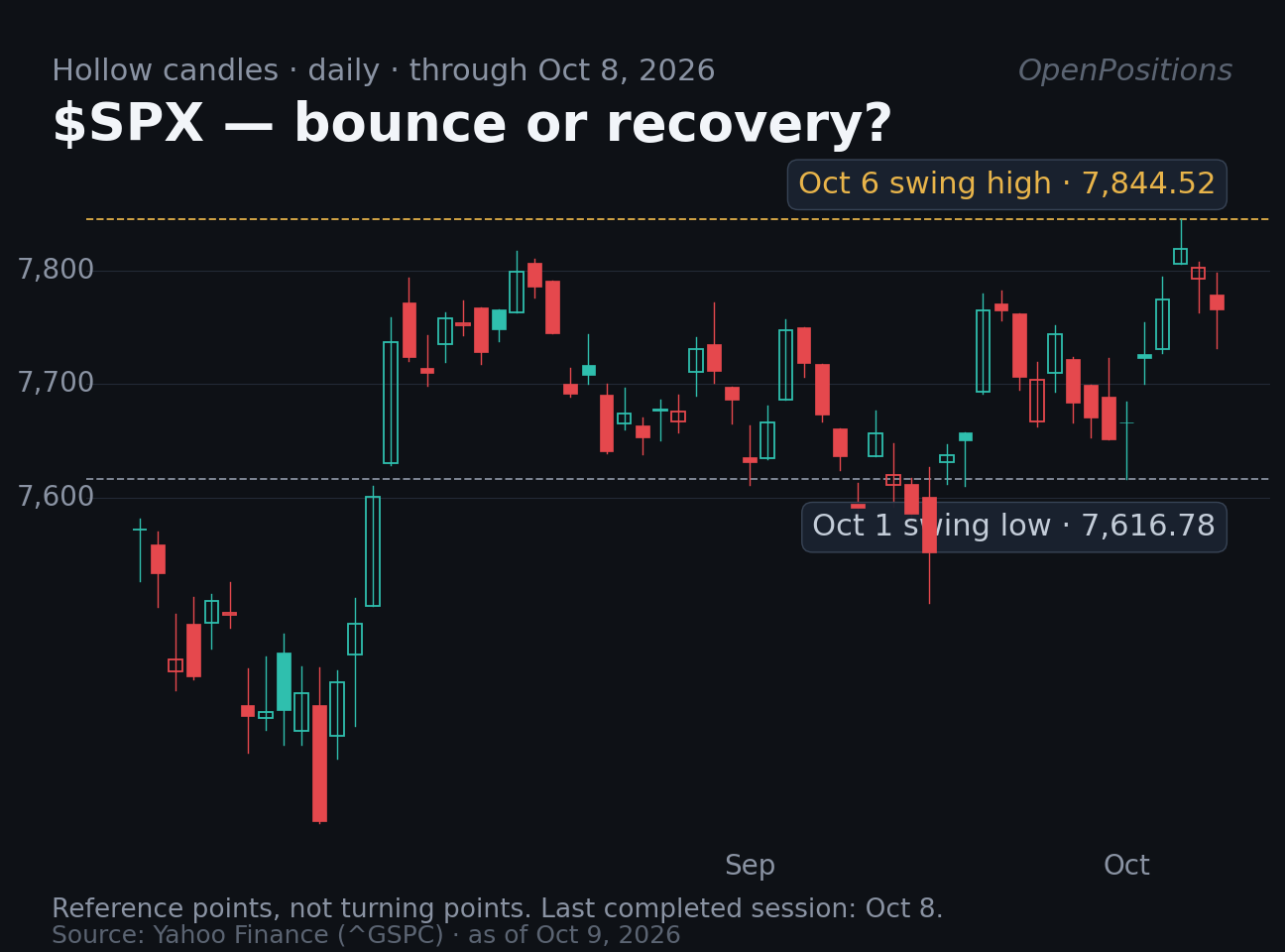
Published chart · Tap chart to enlarge.
Published chart lesson
A bounce describes price rising over a short period; a recovery needs context. The chart marks the recent completed swing high (Oct 6: 7,844.52) and swing low (Oct 1: 7,616.78): ask whether price is reclaiming the former or approaching the latter. These are reference points, not guaranteed turning points. A completed candle gives information that a premarket futures quote cannot — and futures and the cash index are different instruments.
Brief analysis source: SPX daily, Yahoo Finance (^GSPC), through Oct 8, 2026 . Chart uses its own dated Yahoo series; vendor levels can differ.
Three key points
- Index futures pointed to a higher open after Thursday's AI-led sell-off: S&P 500 E-minis +0.4% and Nasdaq-100 E-minis +0.8% at 5:54am ET (Reuters).
- Delta reported September-quarter adjusted EPS of $1.72 and cited a roughly $6 billion increase in 2026 fuel costs (company release); it also cut its full-year adjusted EPS guidance to $5.10–$5.60 from $6.50–$7.50.
- September CPI is scheduled for Wednesday, October 14 at 8:30am ET (BLS).
Read the full brief and sources
- Index futures pointed to a higher open after Thursday's AI-led sell-off: S&P 500 E-minis +0.4% and Nasdaq-100 E-minis +0.8% at 5:54am ET (Reuters). A green open describes this morning's quotes — not the day's outcome.
- Delta reported September-quarter adjusted EPS of $1.72 and cited a roughly $6 billion increase in 2026 fuel costs (company release); it also cut its full-year adjusted EPS guidance to $5.10–$5.60 from $6.50–$7.50. Company-specific risk, like weak guidance, does not diversify away inside a single-stock position.
- September CPI is scheduled for Wednesday, October 14 at 8:30am ET (BLS). A scheduled release can change the outlook while a position is still open.
- Cash-secured put: selling a put creates an obligation to buy shares if assigned. The premium reduces the effective purchase cost, but shares can fall much further. Before selling a single-stock put, ask whether you would still want the shares after disappointing company news. (SPX/XSP index options settle in cash and do not deliver shares — Cboe.)
- Bull put spread: selling a higher-strike put and buying a lower-strike put limits the textbook expiry loss to the strike width minus net credit. That makes the risk measurable, not automatically small — a market gap can still take the position toward its maximum loss.
- Bull call spread: buying a lower-strike call and selling a higher-strike call expresses a bullish view with a net debit and capped upside. Being right about direction is not enough: the move, timing and price paid matter.
- Today's lesson: a cash-secured put, a bull put spread and a bull call spread are all bullish exposures, but they are not interchangeable. Choose the obligation and loss profile before choosing the premium. Waiting is also a valid decision. A 45-day expiry does not remove a CPI release occurring next week.
Recovery evidence: price reclaims the marked prior high and participation strengthens over several sessions. This would support reassessing the cautious interpretation; it is not an automatic entry.
Weakening evidence: price breaks the marked prior low and selling spreads across more stocks. Reassess exposure rather than treating a larger premium as proof of a bargain. Do not infer sustained narrow leadership solely from one day's index-versus-advancers divergence.
A stock falls after weak guidance and its put premium increases. Which matters more before selling: the premium, or whether you can carry the downside and accept ownership at the strike? Explain the trade-off before opening an option chain.
Sources
- BLS: Schedule of Selected Releases, October 2026Oct 9, 2026
- Delta Air Lines: September quarter 2026 financial results (News Hub)Oct 9, 2026
- Reuters: Wall St futures gain as oil slipsOct 9, 2026, 5:54am ET
- OIC: Cash-Secured PutOct 9, 2026
- OIC: Bull Put Spread (Credit Put Spread)Oct 9, 2026
- OIC: Bull Call Spread (Debit Call Spread)Oct 9, 2026
- Cboe: Mini-SPX (XSP) Weeklys Options specificationsOct 9, 2026
Educational framework, not a trade recommendation. No entry signal or return is promised. Full system rules belong in the course.
A green index day can hide single-stock risk
Revised 4:59PM ET · replaces the earlier closing news brief
A rising index does not make every stock a safer put sale. Use today's divergence to separate market direction from the obligation you take on.
Chart analysis
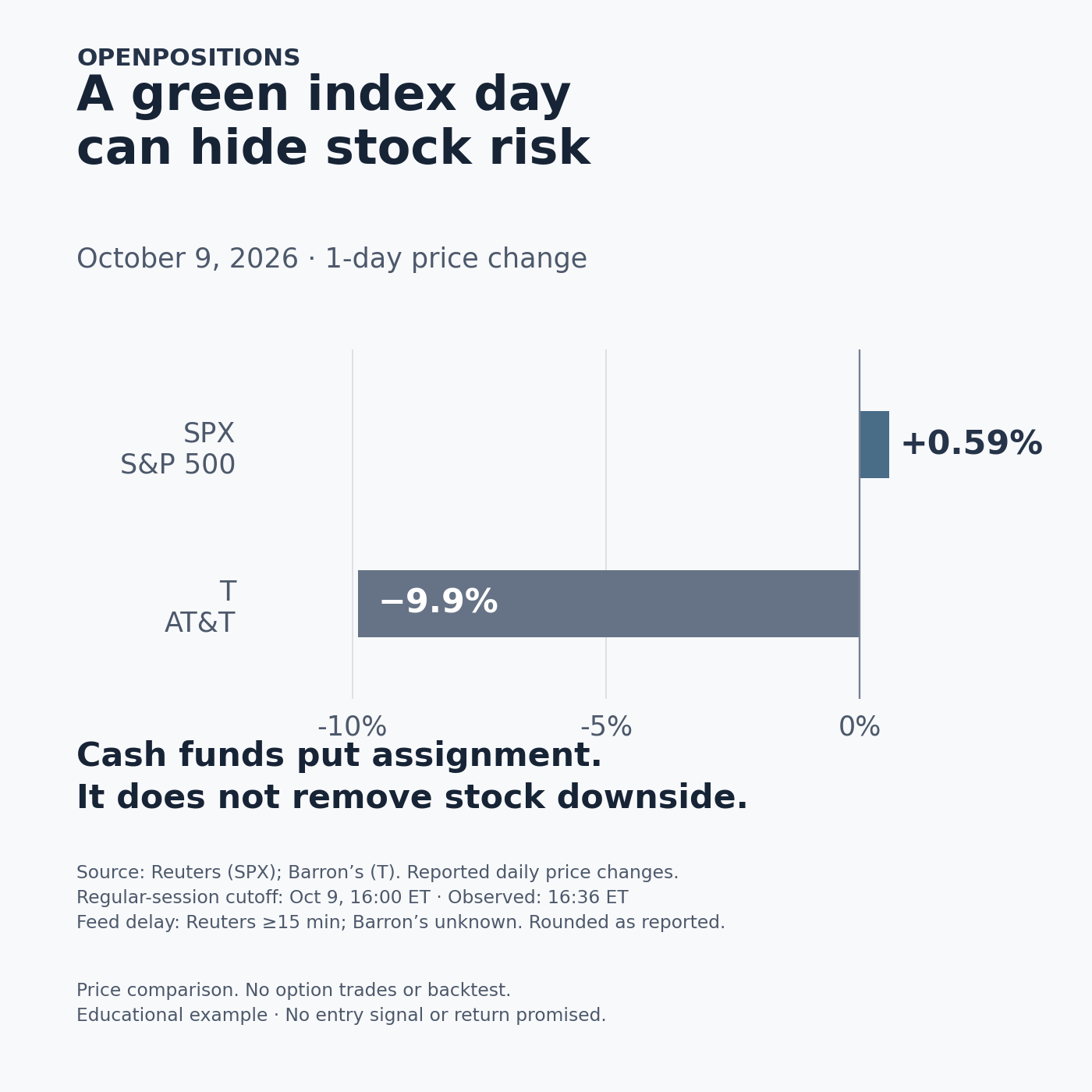
Published chart · Tap chart to enlarge.
Published chart lesson
The index and one stock can move in opposite directions. This comparison shows one day's reported percentage changes; it is not a candlestick chart, trading signal or backtest. Green at the index level does not tell you whether a particular company's risk has improved.
Brief analysis source: SPX +0.59% via Reuters; T −9.9% via Barron's, corroborated by ChartMill. Daily percentage change Oct 8–9, 2026. . Chart uses its own dated Yahoo series; vendor levels can differ.
Three key points
- The S&P 500 gained 0.59% on October 9.
- AT&T (T) fell about 9.9% in the same session.
- These are published closing observations, not live or after-hours quotes.
Read the full brief and sources
- The S&P 500 gained 0.59% on October 9.
- AT&T (T) fell about 9.9% in the same session.
- These are published closing observations, not live or after-hours quotes.
- A cash-secured put is an obligation to buy the stock at the strike if assigned. Cash funds that purchase; it does not protect against a falling stock. Premium reduces effective cost, but substantial downside remains.
- A bull put spread adds a lower-strike long put and limits textbook expiry loss to strike width minus net credit, before fees; it still carries bullish risk. These structures express different obligations and loss profiles. Choose the risk you can carry before comparing the premium.
Before selling a put on a stock that falls while the index rises, would you still want the shares if the business outlook changed? Explain your answer before opening an option chain.
Sources
- Reuters: S&P 500 +0.59% closing reportOct 9, 2026
- Barron's: AT&T/Verizon/T-Mobile drop on SpaceXOct 9, 2026
- ChartMill: S&P 500 top gainers and losers, Oct 9 sessionOct 9, 2026
- OIC: Cash-Secured PutOct 9, 2026
- OIC: Bull Put Spread (Credit Put Spread)Oct 9, 2026
Educational example, not a trade recommendation. No option prices, trades, owner positions or backtest results are represented.